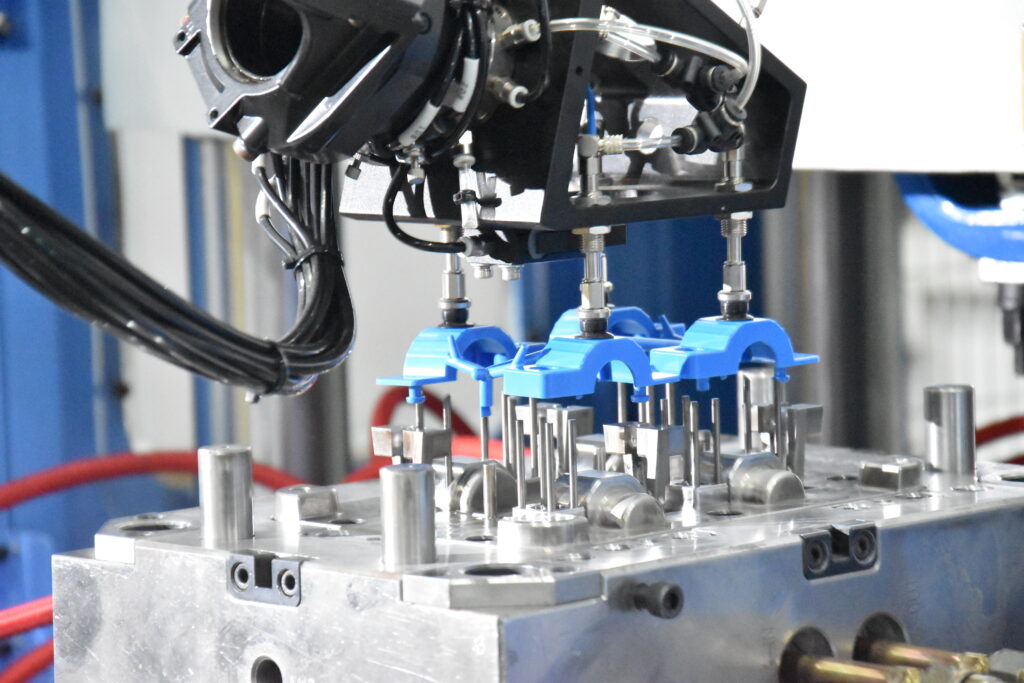
A professional injection molding supplier should control more than molding machines. Buyers should look for DFM review, mold engineering, material handling, documented process settings, measurement capability, maintenance records, traceability, and realistic production capacity. A supplier running 80–500 ton presses, for example, should be able to explain shot-size limits, clamp-force calculations, resin drying conditions, cavity balance, and inspection methods for every project. For demanding programs, process capability should be demonstrated with production data rather than sample appearance alone. ISO 9001, IATF 16949:2016, or ISO 13485:2016 may also matter depending on the industry and product requirements.
Good manufacturing starts before steel is cut. A supplier should review the 3D model, 2D tolerances, resin grade, annual volume, cosmetic requirements, assembly interfaces, and expected service environment before completing the mold design. A wall that changes from 1.5 mm to 4 mm, for example, can cool unevenly and increase the chance of sink, voids, or dimensional variation.
That review should lead naturally into gate, runner, venting, ejection, and cooling choices. Draft requirements vary with material and texture, but many molded surfaces need roughly 0.5°–2° or more, while textured surfaces often need additional draft. A supplier should flag geometry that cannot release reliably rather than accepting a CAD file without discussion.
For more demanding parts, mold-flow analysis can estimate filling pressure, weld-line position, air traps, temperature differences, fiber orientation, and potential warpage before machining begins. Simulation is not a substitute for molding trials, but it can reduce repeated steel changes when a part contains thin flow paths, several gates, glass-filled resin, or tight flatness requirements.
A useful DFM report should tell the buyer what may fail, where it may fail, and what dimensional or tooling change would reduce the risk.
Tool design comes next because production volume has a direct relationship with steel selection and mold construction. Common SPI mold classifications range from Class 105 prototype tools intended for fewer than about 500 cycles to Class 101 production molds designed for more than 1,000,000 cycles. Class 103 tools are commonly associated with production below roughly 500,000 cycles.
Those figures should not be treated as guaranteed mold life. A mold processing unfilled polypropylene at moderate pressure may wear very differently from one processing 30% glass-filled nylon. Glass fiber increases abrasion around gates, runners, shutoffs, sliders, and cavity surfaces, so hardened inserts and replaceable wear components may be reasonable even when annual production volume is moderate.
Cooling design deserves similar attention because cooling can occupy a large part of the molding cycle. Water-line location, diameter, flow rate, scale buildup, insert material, and temperature difference across the cavity can affect both cycle time and dimensional stability. A 5-second reduction on a 30-second cycle raises theoretical output by about 20% before downtime and scrap are considered.
Machine capability must then match the tool rather than simply exceed its clamp-force requirement. A supplier should know the usable shot capacity, screw diameter, injection-pressure limit, tie-bar spacing, platen dimensions, daylight, mold thickness, ejection stroke, and available injection speed of each press.
A machine fleet can be evaluated with practical questions rather than machine count alone:
-
Can a 40 g part run without using an unnecessarily large barrel?
-
Can the press maintain stable transfer position over an 8-hour run?
-
Are injection velocity, hold pressure, back pressure, and screw recovery recorded?
-
Are hydraulic, electric, or hybrid machines selected according to part requirements?
-
How much capacity remains when the plant reaches 80–90% scheduled utilization?
A Plastic injection molding solutions provider should also show how machine selection changes when the same product moves from a one-cavity pilot tool to a four-cavity or eight-cavity production mold. More cavities increase shot weight and output, but they also raise requirements for runner balance, cooling consistency, platen size, clamp force, and automation.
Material handling becomes more important as resin performance rises. ABS and polypropylene are relatively forgiving compared with hygroscopic engineering materials such as PA, PC, PET, and PBT. Moisture left in some engineering polymers can cause hydrolysis, splay, reduced mechanical properties, or unstable appearance even when molded parts initially look acceptable.
Drying therefore needs documented time, temperature, and moisture control. The supplier should be able to identify whether resin is stored in sealed containers, transferred through closed lines, dried with desiccant equipment, and protected from prolonged room exposure after drying. For regulated projects, lot numbers should link incoming resin to production batches.
Material knowledge should extend beyond processing temperature. A supplier working with PA66 containing 30% glass fiber needs to understand anisotropic shrinkage and fiber orientation, while a supplier molding clear polycarbonate must manage contamination, drying, cosmetic defects, gate stress, and surface handling differently.
The same discipline applies to molding parameters. A stable process normally records barrel temperatures, mold temperature, injection velocity, transfer position, peak pressure, hold pressure, hold time, screw recovery, back pressure, cooling time, and cycle time rather than allowing operators to change settings without documentation.
A supplier may use filling studies, gate-seal studies, short-shot analysis, cavity-pressure sensors, or statistical process control to establish an operating range. When production lasts 100,000 cycles, a process that only works at one narrow setting can create much more scrap than one with a verified window that tolerates normal material and environmental variation.
Sample approval should come from documented production conditions, not from selecting five attractive parts from an unstable molding trial.
Inspection methods must then match drawing requirements. Calipers may be adequate for a ±0.20 mm nonfunctional dimension, while positional features, hole locations, flatness, profiles, and complex datums may require a CMM, optical measuring system, vision equipment, calibrated gauges, or custom fixtures.
For repeated dimensions, process capability data can provide more information than a simple pass/fail report. Many industrial customers request Cp or Cpk studies, often using 30 or more consecutive samples depending on their internal procedure, drawing requirements, and validation plan. Acceptance criteria should be agreed before production rather than invented after measurements are collected.
The quality system should also define what happens when parts fail inspection. Nonconforming material needs identification, segregation, disposition, root-cause review, and controlled reinspection. Regrind use, if permitted, should be specified because an uncontrolled percentage of recycled material can alter color, viscosity, mechanical performance, and lot consistency.
Industry requirements can raise the documentation level considerably. IATF 16949:2016 remains widely used for automotive production supply chains, while ISO 13485:2016 applies to medical-device quality management and was reconfirmed as current by ISO in 2025. The U.S. FDA's Quality Management System Regulation became effective on February 2, 2026 and incorporates ISO 13485:2016 by reference for medical-device manufacturing requirements.
For automotive work, buyers may also need PPAP records, control plans, PFMEA documentation, material certifications, dimensional reports, and customer-specific requirements. For electronics or industrial products, documentation may instead focus on resin certification, RoHS or REACH declarations, lot traceability, cosmetic standards, and functional inspection.
Production traceability should connect the shipped carton to the conditions under which the parts were made. A useful record can include resin lot, colorant lot, mold number, cavity number, press number, production date, shift, operator, process revision, inspection status, and packaging batch.
Cavity-level identification becomes especially useful in four-, eight-, or sixteen-cavity tools. If cavity 6 develops a dimensional problem after 250,000 cycles, the supplier can investigate affected production without treating every cavity as identical. Maintenance records can then show whether the issue followed gate wear, ejector wear, slide movement, vent contamination, or another mechanical change.
Maintenance capability matters for the same reason. Mold servicing may include cleaning vents, checking shutoffs, inspecting ejector pins, lubricating slides, checking water circuits, removing deposits, replacing seals, and measuring wear areas. Service intervals should reflect resin, tool design, cycle count, operating temperature, and previous maintenance findings.
Capacity planning needs equally specific numbers. An eight-cavity mold running a 24-second cycle has a theoretical rate of 1,200 parts per hour: 3,600 seconds divided by 24 seconds, multiplied by eight cavities. At 85% effective uptime, practical output falls to about 1,020 parts per hour before scrap is deducted.
A buyer requiring 500,000 parts per month should therefore ask how many scheduled machine hours are available, what scrap assumption is used, how mold maintenance is included, and whether backup presses can accept the same tool. A machine being physically present on the factory floor does not show that its production time is available.
Secondary operations should be reviewed with the same level of detail. Ultrasonic welding, heat staking, pad printing, laser marking, insert installation, machining, painting, assembly, leak testing, or packaging may add several process steps after molding, and each step introduces its own fixture, inspection, capacity, and traceability requirements.
Supplier assessment is more useful when based on records from comparable production. Ask to review a previous part using similar resin, tolerance, part weight, cavity count, surface requirement, and annual volume. If the project requires 30% glass-filled PBT with ±0.05 mm feature control, experience limited to large unfilled PP housings provides little information about the supplier's ability to hold that requirement.
Before tooling approval, request the DFM report, proposed mold class, steel specification, cavity count, expected cycle time, machine assignment, inspection plan, maintenance approach, trial schedule, and production-capacity calculation. Comparing those documents across two or three suppliers usually reveals larger differences than comparing mold quotations alone.