Automatic packaging machines handle sticky or powdery substances by controlling how material moves before it reaches the package. Sticky foods often use piston or positive-displacement pumps, heated hoppers, agitators, shut-off nozzles, and suck-back filling. Powders commonly use servo augers, hopper agitators, dust extraction, and checkweighers. A line running at 60 packs per minute produces 3,600 packs per hour; an average 2 g overfill adds 7.2 kg of product giveaway every hour. Stable feeding and clean sealing usually matter more than maximum machine speed. Equipment selection therefore depends on viscosity, bulk density, particle size, fill weight, package format, sanitation requirements, and the amount of product variation expected during a production shift.
A packaging machine first has to keep material moving at a repeatable rate. Water-like liquids can flow through a hopper outlet under gravity, but honey, creams, tomato-based sauces, gels, and pastes may remain on hopper walls or move slowly through narrow passages. A 20°C change in product temperature can substantially alter the viscosity of many food formulations, so a filler adjusted during a warm startup may behave differently several hours later. Jacketed hoppers, slow agitators, wall scrapers, and wider product passages are used where temperature and adhesion affect flow. The next engineering question is how to measure each dose once the product reaches the filling section.
For viscous products, piston and positive-displacement filling systems are common because the machine physically moves a measured amount instead of waiting for gravity. A servo-controlled piston can repeat a programmed stroke while a pump system meters product according to pump displacement and rotation. At 40 packs per minute, even a 0.5-second increase in each filling cycle can limit available production time, so nozzle diameter, hose length, pump capacity, and viscosity need to be considered together rather than adjusted separately.
A larger nozzle can shorten filling time, but it can also make product cutoff harder. A smaller nozzle can improve placement while increasing pressure and fill time. On a 500 g package, a 1% dosing difference equals 5 g, enough to become expensive when hundreds of thousands of units are produced.
Product cutoff becomes the next problem because viscous material may continue moving after the pump or piston stops. Sauces can drip, while creams and gels can form a strand between the nozzle and package. Shut-off nozzles close near the discharge point, and suck-back systems briefly reverse product movement to pull residue away from the tip. Diving nozzles can descend into bottles or pouches and rise as filling progresses. If a line produces 50 packs per minute for an 8-hour shift, it attempts 24,000 fills, so even a 1% contamination rate can affect about 240 packages before rework or rejection is considered.
Powders require a different feeding method because particle behavior depends on more than weight. Flour, cocoa, protein powder, powdered milk, spices, drink mixes, and pharmaceutical powders can have very different particle sizes and bulk densities. A powder occupying 1 L after aeration may settle into a noticeably smaller volume after vibration or transport. A volumetric filler therefore cannot assume that the same volume always has the same mass. Auger filling is widely used when gravity feeding is too inconsistent, which leads directly to the relationship between screw movement and dose accuracy.
An auger rotates inside a tube and meters powder toward the package. Servo control allows the machine to command a defined number of revolutions rather than relying on an uncontrolled feed. For a nominal 250 g fill, a 2% error represents 5 g per package; across 10,000 packs, that difference reaches 50 kg. Auger diameter, pitch, rotational speed, tooling clearance, hopper level, and powder condition all affect the amount delivered per revolution. Fine cohesive powder may also require an agitator above the auger so material continues entering the screw consistently.
| Product behavior | Common machine arrangement | Main measurement concern |
|---|---|---|
| Thick sauce or paste | Piston or positive-displacement pump | Volume consistency and cutoff |
| Fine cohesive powder | Servo auger with agitation | Bulk-density variation |
| Free-flowing granules | Cup or weighing system | Flow rate and target weight |
| Aerated powder | Auger plus checkweigher feedback | Settling and density change |
Agitation has to be controlled rather than simply increased. Excessive stirring can introduce more air into a fine powder, alter bulk density, damage fragile particles, or create additional dust. Too little movement can allow bridging above the hopper outlet. A machine operating at 70 packs per minute needs material available for a new dose roughly every 0.86 seconds, leaving little room for intermittent hopper flow. Level sensors can keep the working amount within a selected range, while controlled agitator timing limits unnecessary movement.
Dust control becomes important immediately after stable feeding has been established. Fine particles can leave the filling tube, settle on sensors, enter mechanical areas, or collect where the package will later be sealed. Reducing the powder's free-fall distance is one practical method: the filling tube can extend farther into a pouch or container instead of releasing material from a high position. Local extraction can remove suspended particles around the dosing point. On a line processing 1,000 kg during a shift, even 0.2% uncontrolled product loss represents 2 kg of powder outside saleable packages.
Faster auger rotation does not automatically produce more finished packs. If additional dust raises rejects from 0.5% to 2%, a nominal speed increase can produce fewer acceptable packages by the end of the shift.
Seal cleanliness is closely connected to dust and drip control. Horizontal or vertical sealing jaws need packaging material between them without food paste or powder occupying the intended seal area. Temperature, pressure, and dwell time can be set correctly while a contaminated seal still performs poorly. Machines therefore coordinate filling completion, nozzle withdrawal, film movement, and jaw closure. A line making 30,000 pouches with a 1.5% seal-reject rate loses 450 packages, while reducing the rate to 0.5% cuts the rejected quantity to 150.
Weight control adds another layer because filling equipment can repeat its movement while the material itself changes. Checkweighers measure completed packs and can show whether average weight is moving away from the production target. Some integrated lines use weight information to correct subsequent auger revolutions or filler settings. If a 1 kg product is routinely overfilled by only 0.7%, each package contains 7 g more than the nominal amount. At 100,000 packages, the additional material reaches 700 kg, making small improvements in average dosing commercially significant.
Package speed should therefore be judged against acceptable output rather than the largest number displayed on the control panel. Consider two lines operating for 8 hours. A machine producing 80 packs per minute at 96% acceptable output yields about 36,864 acceptable packs. A second machine producing 78 packs per minute at 99% acceptable output yields about 37,066. The nominally slower machine finishes the shift with roughly 202 more acceptable packs before differences in cleaning downtime are included.
Product-contact design becomes important when the shift ends or a recipe changes. Sticky food can remain behind seals, inside hoses, around piston components, and in hopper corners. Powder can settle around auger tooling and underneath removable assemblies. Quick-release hoppers, detachable nozzles, accessible augers, smooth product-contact surfaces, and reduced numbers of difficult joints shorten cleaning work. In a plant making 3 product changes during a shift, reducing each changeover from 40 minutes to 25 minutes returns 45 minutes to scheduled production.
Stainless steel is commonly used for food-contact construction because it tolerates repeated cleaning and provides a smooth, durable surface when correctly fabricated. Surface finish, weld quality, gasket design, drainage, and access can matter as much as the basic material grade. Food plants operating under HACCP-based programs introduced widely after the 1990s also need cleaning procedures that can be repeated and documented. Packaging equipment should therefore allow operators to inspect the areas that actually contact sauce, paste, or powder instead of requiring extensive dismantling for routine checks.
Automation also helps keep multiple machine sections synchronized. Hopper-level sensors can request more product, servo motors control auger or piston movement, photoelectric sensors confirm package position, and temperature controllers maintain sealing conditions. If a machine runs at 60 cycles per minute, each full package cycle lasts only 1 second. Filling, product cutoff, film movement, positioning, and sealing must occur inside that cycle or through overlapping machine operations without allowing one section to interfere with another.
Stored recipes reduce manual setup when a plant handles several products. A recipe can contain auger revolutions, pump speed, piston stroke, fill timing, bag length, sealing temperature, and other machine-specific parameters. Returning to a previously qualified product therefore does not require operators to rebuild every setting from memory. If manual setup takes 30 minutes and stored settings reduce it by 30%, about 9 minutes can be removed from each comparable setup before verification and sanitation work.
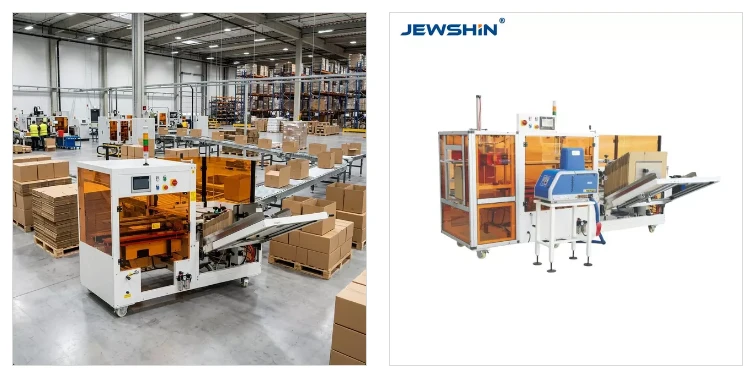
Secondary packaging has to keep pace with the filler as well. Filled pouches, bottles, or cartons eventually need grouping, case packing, and shipping preparation. An automatic carton erector can form corrugated cases at a controlled rate before downstream case packing. If the primary machine produces 60 units per minute and each shipping case holds 12 units, downstream equipment needs capacity for at least 5 completed cases per minute, with additional margin for short production surges and planned line balancing.
Material testing should take place before final machine settings are accepted. Testing 10 packages can reveal obvious mechanical problems, but it gives limited information about a production run containing tens of thousands of cycles. A more useful qualification can examine repeated samples at startup, normal running conditions, after hopper replenishment, and near the end of a batch. A 100-pack sample with an average fill close to target can still contain individual packages outside the desired range, so average weight, standard deviation, minimum, maximum, and reject count should be reviewed together.
Sticky products should also be tested at the temperatures expected during actual production. A sauce filled at 45°C during equipment trials may behave differently if routine production starts at 25°C. Powder samples should be tested after realistic storage and handling because settling, moisture exposure, and transport vibration can change flow. A filler selected from a specification sheet stating only “powder” or “viscous liquid” has too little information for reliable sizing; density, viscosity range, particle size, inclusions, temperature, target weight, and required rate provide a more useful engineering basis.
Maintenance intervals influence long-run accuracy because product-contact components wear. Auger tooling can lose dimensional consistency, seals can deteriorate, piston components can leak, and nozzle valves can stop closing cleanly. Suppose a machine makes 50 packs per minute during two 8-hour shifts: it completes up to 48,000 cycles per day. After 250 production days, that operating pattern approaches 12 million cycles. Inspection schedules should therefore be based on actual cycles, product abrasiveness, cleaning conditions, and manufacturer recommendations rather than calendar time alone.
A well-matched line treats sticky and powdery materials as separate process problems. Viscous products need controlled movement and clean cutoff; powders need stable feeding, density management, and dust containment. At 60 packs per minute, reducing average overfill from 2 g to 0.5 g saves 5.4 kg of product per operating hour, while lowering rejects from 2% to 0.5% preserves another 54 packages every hour. Machine efficiency is best measured by acceptable packages produced per shift, product used per acceptable package, cleaning time, and repeatable fill performance—not nominal cycles per minute alone.