A car fragrance is not a home diffuser moved into a cup holder. The cabin is a small enclosed space that can reach high temperatures, packed with plastics and textiles that a fragrance can stain or soften. That combination changes the format decision, the material list and the testing plan. Brands that treat car fragrance as a packaging exercise usually discover the difference after the first summer.
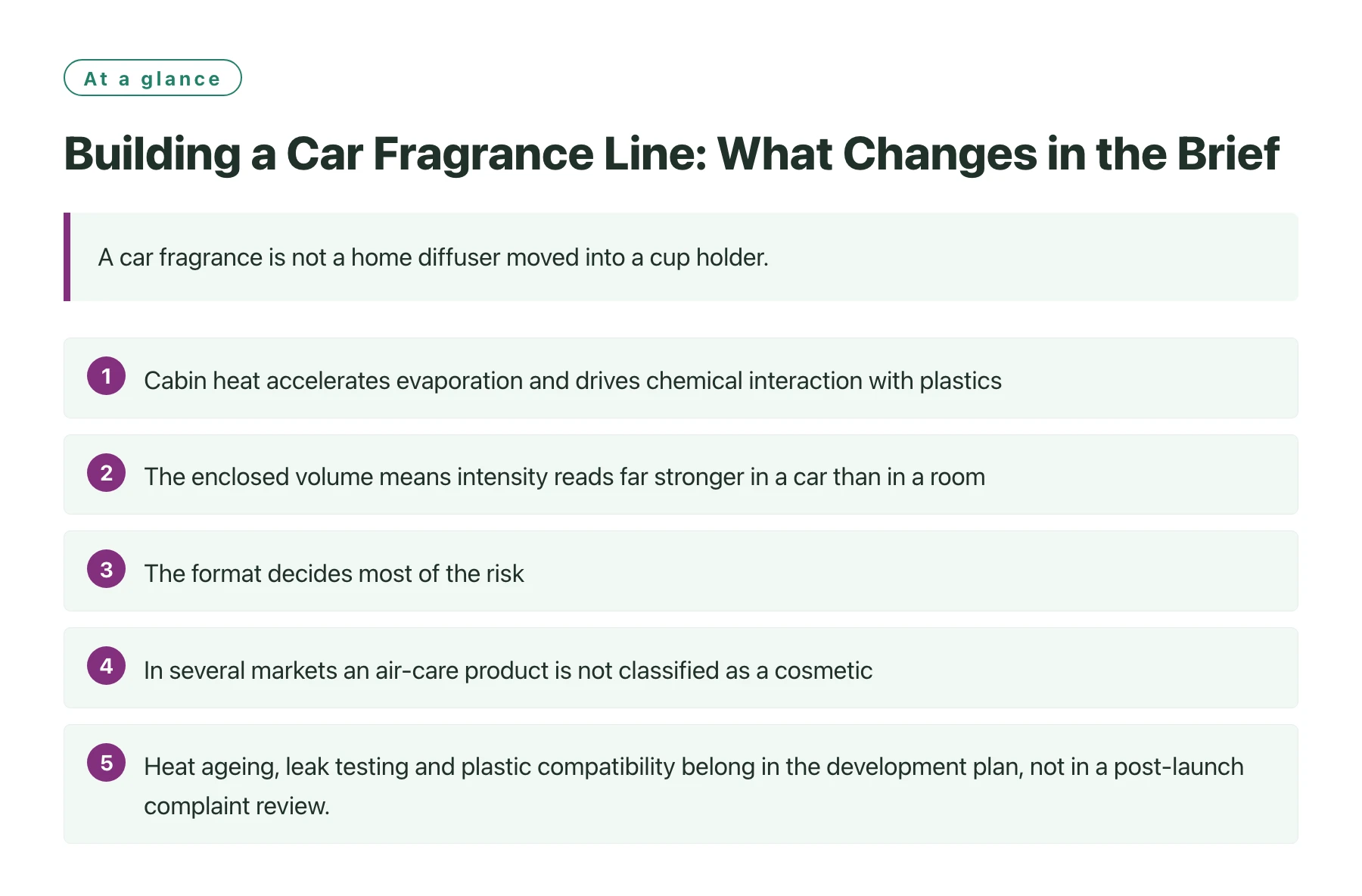
Key takeawaysCabin heat accelerates evaporation and drives chemical interaction with plastics, so a formula that behaves on a shelf can misbehave behind glass. · The enclosed volume means intensity reads far stronger in a car than in a room, and heavy sweet accords quickly become cloying. · The format decides most of the risk, because a vent clip, a hanging card and a liquid diffuser fail in completely different ways. · In several markets an air-care product is not classified as a cosmetic, so the labelling and documentation route differs from a body product. · Heat ageing, leak testing and plastic compatibility belong in the development plan, not in a post-launch complaint review.
Fragrance brands expand into car products for a predictable reason: the category sells, it uses existing scent assets, and the unit is small and light. The mistake is assuming the development process carries over unchanged.
A car interior is a demanding environment. Surfaces get hot, ventilation is limited, and the product sits within arm's reach of the driver. Each of those facts has a technical consequence, and most of them are cheaper to address at the brief stage than after a mould has been cut.
This guide covers the decisions that differ from a home or personal fragrance project, in the order they are worth making.
Why the cabin rewrites the brief
The first thing to accept is that the environment, not the scent, sets the agenda. Three conditions do most of the work: temperature, the enclosed volume, and the surfaces the product sits against.
A brief that names a scent and a format but says nothing about those three conditions has left the hardest part of the project undefined.
Heat accelerates everything
A parked car in summer becomes a warm box, and warmth speeds up evaporation, absorption and chemical reaction alike. A liquid format that releases scent gradually at room temperature can empty itself quickly in a hot cabin, and a gel can dry out or separate.
This is why heat ageing belongs in the development plan rather than the complaint file. The useful question is not whether the product smells good today but how it behaves after weeks at elevated temperature.
Plastics and trim are part of the formulation
Fragrance concentrates are solvents as much as they are aromas, and some materials interact with the polymers used in dashboards, vents and trim. The visible results range from a dull patch to a softened surface, and none of them can be repaired.
Ask for compatibility testing on the actual materials the product will touch, and be specific about them. A generic statement that the product is plastic safe is not evidence, and the brand carries the consequences of a stained dashboard.
The enclosed space changes how a scent reads
A car holds a tiny volume of air compared with a room, and its occupants cannot step away. Accords that feel rich in a living room can feel heavy within minutes in traffic, and strong sweetness is the usual culprit.
Fresh, woody and clean directions generally survive the translation better, and lighter concentrations are more forgiving because the load can be tuned without rebuilding the scent.
How to brief a car fragrance project
- Choose the format before the scentThe delivery method sets the risk profile, so pick between a vent clip, hanging card, gel, sachet or diffuser first.
- Define the release profile in wordsDecide whether the product should open strongly and fade or stay steady for weeks, since the two need different carriers.
- List the surfaces it will touchName the plastics, coatings and textiles involved so compatibility testing can be planned against real materials.
- Set the intensity for occupants, not roomsTest in an actual vehicle with the windows closed, at least twice, before accepting a sample as final.
- Fix the market classification earlyConfirm whether the product is regulated as air care or as a cosmetic in each target market before artwork is designed.
- Plan the refill or replacement pathDecide how long the unit lasts, how the customer knows it has finished, and what they do with it afterwards.
Car formats and how each one fails
| Format | How it releases scent | Practical strengths | Where it fails in a hot cabin |
|---|---|---|---|
| Vent clip with a scent pad | Airflow across a saturated pad | Immediate effect, cheap to refresh | Pad dries unevenly and intensity drops sharply |
| Hanging card | Passive evaporation from coated board | No installation, simple to brand | Board warps and the scent fades faster than expected |
| Gel can | Slow release from a gelled base | Steady output, easy to place | Gel shrinks, cracks or separates under heat |
| Liquid diffuser with a wick | Capillary draw through a wick | Adjustable output, longer life | Leaks when tipped and attacks some plastics |
| Scented sachet or pouch | Passive release from a fabric or paper pouch | Very low unit cost, useful for enclosed spaces | Odour collapses quickly once the surface dries |
The table is a reminder that format choice is a release-profile decision disguised as a design decision. Once the release mechanism is fixed, the realistic range for the scent load narrows considerably, and the perfumer is working inside a box rather than around an idea.
The most avoidable failure in this category is a launch that passes every test in the office and fails in a customer's car in August. A fragrance formula is approved at room temperature, on paper, on a bench, in a laboratory that is comfortable for humans. None of those conditions resembles a parked vehicle. Budget for a heat-ageing check and one real-vehicle test before the packaging order is placed, and treat a supplier's refusal to discuss compatibility testing as a warning rather than a detail. A manufacturer such as Xuelei, which already fills home and personal fragrance formats, should be able to describe how it tests a new format before it quotes for one.
What to settle before artwork is drawn
Once the format and the load are agreed, three further questions decide whether the product can be sold in the markets you are aiming at.
They are administrative in appearance and central in practice, because each one can force a change to the label, the packaging or the formula.
The material list has to fit the format
Fragrance materials carry use restrictions that vary by product type, and the IFRA Standards Library is where those restrictions are published [1]. A compound written for a personal fragrance is not automatically suitable for an air-care application, and the practical limit is usually set by the most restricted material in the formula rather than by the perfumer's preference.
Classification decides the paperwork
In several markets an air-care item is not treated as a cosmetic, which changes the labelling, documentation and notification route that applies to it. Get this confirmed for each market before the artwork is drawn, because a label designed against the wrong classification is a reprint.
If you also intend to sell a matching personal fragrance with the same scent, expect the two products to follow different routes even though they share a compound.
Test the finished unit, not the oil
A formula that behaves well in a laboratory vessel can behave badly inside a vent clip or a gel can, because the container is part of the delivery system. Test the assembled unit, including the seal and the wick where relevant, and repeat the test after heat ageing.
If you want to check whether a supplier already runs air-care or home fragrance formats alongside personal fragrance, Learn more about the supplier's category list before asking for a sample plan.
Sources
- IFRA Standards Library (International Fragrance Association) —— The IFRA Standards Library lists the restrictions the fragrance industry applies to individual fragrance ingredients, based on safety assessments; it is the reference point for compliant fragrance formulation.
Frequently asked questions
Is car fragrance regulated as a cosmetic?
Not in every market. An air-care or automotive product is often treated as a chemical or consumer product rather than a cosmetic, which changes the labelling and documentation route. Confirm the classification for each target market before drawing the artwork, because the answer can affect claims as well as warnings.
Which car fragrance format is easiest for a first launch?
A vent clip with a replaceable pad or a hanging card usually involves the fewest components and the lowest tooling cost. Liquid diffusers offer a longer life but add leak and compatibility risk, so they suit a brand that is prepared to test the sealed unit thoroughly.
Why does my car fragrance smell too strong?
A cabin holds far less air than a room, so the same formula reads more intensely. Sweet and heavy accords become cloying fastest. Ask for a lower fragrance load or a lighter, fresher direction, and evaluate it in a closed vehicle rather than in an office.
Do I need plastic compatibility testing?
Yes, if the product touches interior surfaces. Fragrance concentrates can interact with polymers, coatings and textiles, and the result is usually permanent. Test against the actual materials the unit will contact, including the vent blades or trim it is clipped to.
How long should a car fragrance last?
There is no single standard, because format, load and cabin conditions all influence the answer. Decide the intended life in the brief, then test the assembled unit under heat ageing to see whether it delivers that life steadily or dumps its scent in the first days.